

Recently our friends Julie, Dean, Barb and Tim wanted to come over to Bret’s Table to cook and enjoy dinner together. Barb also wanted to show-off our kitchen to her son and daughter-in-law who were visiting from California. Of course, anytime friends call and ask, “Can we cook at Bret’s Table?” if we’re available, the answer is always, “Absolutely, come on over and bring a bottle of wine.”
Being inspired by Hiroko’s recent visit, I wanted to come up with a Japanese menu for the occasion. With both her books sitting on the counter, The Sushi Experience and The Japanese Kitchen, I picked up the latter and started thumbing through it, asking myself, “hmm what to have, what to have.” Due to the August heat, I was looking for recipes where the oven would not have to be used at all or if so, only briefly. Let’s just say, I wasn’t about to roast a whole stuffed salmon, when it’s 90 degrees outside.
Also, as with any multi-course menu that I plan, I was looking for flavor combinations that would compliment each other or at least tie each course together with a common thread. Sometimes I’m more successful than others in accomplishing that goal. This time, it seemed to work beautifully. Maybe it’s because I sent a quick email off to Hiroko to verify that my ideas would tie together or at least be successful enough so that if one was Japanese, one wouldn’t be offended.
 Barbs’ son, Lance, is a big foodie and wanted to learn a new technique or two in the process of our cooking together. He’s such a foodie that the last time Barb and Tim and Julie and Dean were over prepping for a dinner together, we called Lance and his wife, Meghan, for we were cooking out of Thomas Keller’s book, The French Laundry. Lance and Meghan had been fortunate to have just eaten at the restaurant of the same name. Since none of us had ever eaten there, we could say that what we were cooking was just as good and wasn’t costing $250 per person.
 Anyway, for the Japanese menu, I decided that we should tackle Hiroko’s Heavenly Rice Crackers which are quite simple to make and truly heavenly to eat with their crisp texture and nutty flavor. To accompany them, we made an Edamame Pâté. I had recently been given the recipe for the pâté and had been wanting to try it out. However, as soon as we tasted the original recipe, we promptly changed it, as it was too bland for our taste.
 For the second course, I was intrigued by Hiroko’s recipe for a Duck Dumpling in Consommé for two reasons. One was the fact that the dumpling was made by combining duck breasts and sea bass into a paste. I would have never thought of combining these two proteins. And secondly, how Hiroko explained making the dumpling shape, I immediately thought of a quenelle. Of course, I’m always a sucker for wanting to practice a technique and a quenelle does take a little effort to get the hang of it.
 To continue the fish theme, I decided on a Miso-Marinated Salmon with Spinach Sauce alongside perfectly-steamed brown rice. Hmm…spinach sauce. I like spinach, but pureed? However, I thought that since Jon’s been on this spinach kick lately, now would be the time to venture into this territory before it was too late.
 For dessert, we would repeat what Hiroko and I made for a party when she was here : a rhubarb soup with Izzy’s vanilla bean ice cream and brandied cherries. I know it’s not very Japanese, but the rhubarb was from the garden and we had brandied the cherries earlier and they were sitting on the refrigerator shelf, begging to be enjoyed.
I handed out the recipes and divided everyone into teams. Julie and Dean, after many taste tests, came up with the new version of the Edamame Pâté. Meghan rolled out and baked the crackers. Lance and I dug into the dumpling and consommé recipe and Barb and Tim tackled the sauce for the spinach and well as cooked the rhubarb soup. Last but not least, Jon was in charge of the dishwashing throughout the evening.
After much laughter and no kitchen mishaps, we sat down to enjoy dinner and several bottles of 2009 Shine – Heinz Eifel – Riesling. We took lots of pictures, but unfortunately, not one photo of any of the food. We were all too busy taking pictures of each other. You’ll have to trust me that it all turned out beautiful as well as delicious.
I have made another batch of the crackers. They are easy to make and could be enjoyed not only with the Edamame Pâté but also with a fresh tomato salsa. Making the salsa may be a challenge though if you happen to have a partner that turns every last tomato into a paste before you can say “fresh tomato brusschetta”.
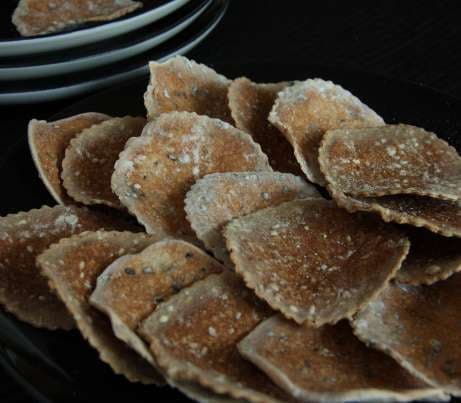 HEAVENLY, CRISPY RICE CRACKERS
Yields 32 crackers
2 ½ ounces (about ½ cup) cake flour
3 ounces joshinko (rice flour)
½ teaspoon baking powder
¼ teaspoon salt, stirred into a scant ½ cup lukewarm water
1 ½ tablespoons white sesame seeds
1 ½ tablespoons black sesame seeds
Cake flour for dusting
In a medium bowl, combine the flours and baking powder. Add the salted lukewarm water to the flour mixture little by little, stirring, until the mixture has a dough-like consistency.
Divide the dough into two portions. Flatten one portion, sprinkle the white sesame seeds on top and knead them in. Incorporate the black sesame seeds into the other piece of dough in the same way. Shape each piece of dough into a disk. Wrap the disks in plastic wrap and refrigerate them for 1 hour.
Heat the oven to 400ºF.
On a lightly floured counter, form each disk into a log about 2/3 inches in diameter. Cut each log into quarters, then each quarter into quarters, to make 32 dough disks. Dredge the cut sides lightly in flour to prevent them from drying out.
With a rolling pin, roll each disk into a circle 2 ½ inches in diameter. Arrange the thin disks on a parchment or Silpat lined baking sheet and transfer it to the heated oven. Bake the crackers until crisp and light golden, about 15-20 minutes, turning the crackers over halfway through the baking process.
Transfer the crackers to a rack to cool, and then store them in a jar with a tight-fitting lid. Serve the crackers with your favorite spread or salsa.


Headed to Points South
You have to love a tailwind when you’re at 30,000 feet; it often puts you at your destination earlier than anticipated. Recently for us, it meant landing in Saint Louis a half hour ahead of schedule. After grabbing our luggage and boarding one of those lovely shuttle buses for a ride to Hertz, we found our Toyota was waiting for us. I was a little hesitant riding in a Camry due to all the recent publicity about unexpected acceleration, but we survived the car and Jon’s aka JT’s driving (just kidding, he actually does quite well.). For the most part, Hertz Never Lost (which I often refer to as Ever Lost for the amount of time sitting on the side of the road, trying to make sense of where “Madge” was taking us) directed us where we needed to go including Festus, Potosi, and Crystal Lake Park, all the big cities around Saint Louis.
According to our green-behind-the-gills waiter, there wasn’t a lemon in the house. I wondered how there could be no lemons when every glass I saw had a wedge. Reluctantly, we conceded and limes were squeezed. The next ingredient was simple syrup. “Simple what?” we were asked. You know — equal parts sugar and water, bring to a boil, simmer until sugar dissolves, and then cool. They had all the necessary alcohol in the house, so we were in good shape there, it was just a matter of making the simple syrup and squeezing (in our case) some limes.
I have to say that after the 15 minute wait, the outcome was not horrible, but not great, either. Most disappointing was the fact that it came out in a miniature lowball glass. It did have a sugared rim, but also had floating in it an eighth of a lime. The size of the lime wedge would have been more suited as part of a bowl of freshly-made guacamole. I was grateful for the valiant effort and I hope that the bartender was inspired to keep experimenting.
I won’t go into details about the menu, but feel free to check out their website. I will say they can accommodate a large crowd and were attentive to our group of 11 people the night we were there for dinner.
After dinner, Jon and I headed to Bad Dog Bar & Grill for some country western dancing. I was beginning to wonder if Missouri was really part of the south, as there was a seeming lack of southern hospitality, i.e. not one soul said hello. Although I’m Mr. Introvert, I made the first move and asked the line dance instructor for a spin around the floor. Shortly afterwards, however, Missouri’s southern hospitality was redeemed as new friends Robb and Greg said hello to us. With the hour getting later and later, we said our goodbyes and headed south to Festus to visit Jon’s parents.
Saturday’s drive south to Potosi was lovely as we traveled through the rolling hills of southeast Missouri. We were headed to Boo’s Market for lunch and a mini high school reunion with Jon’s classmates. Then we returned to Festus for dinner with JT’s parents and niece at the Country Café.
Sunday, we enjoyed a delightful lunch with Jon’s family which included an unbelievable array of desserts including an Angel Food Cake, Coconut Cream Pie, a Four Layer Dessert and Jon’s favorite Lemon Ice Box Pudding.
The point of all this rambling is that I’ve heard for years, mainly from JT, how much there is to see and do in Saint Louis. There’s supposed to be some fantastic food in the fair city to our south. It will definitely require a trip back, if not two or three, to see and eat our way through the gateway to the west. Then there is always the ride up the arch. Maybe we’ll do that before lunch.